Pareto Frontier
First remove any option when another is at least as good on every important measure and better on one, then choose among the real trade-offs.
Remove the plans that are plainly worse, then be honest about which trade-off you are choosing.
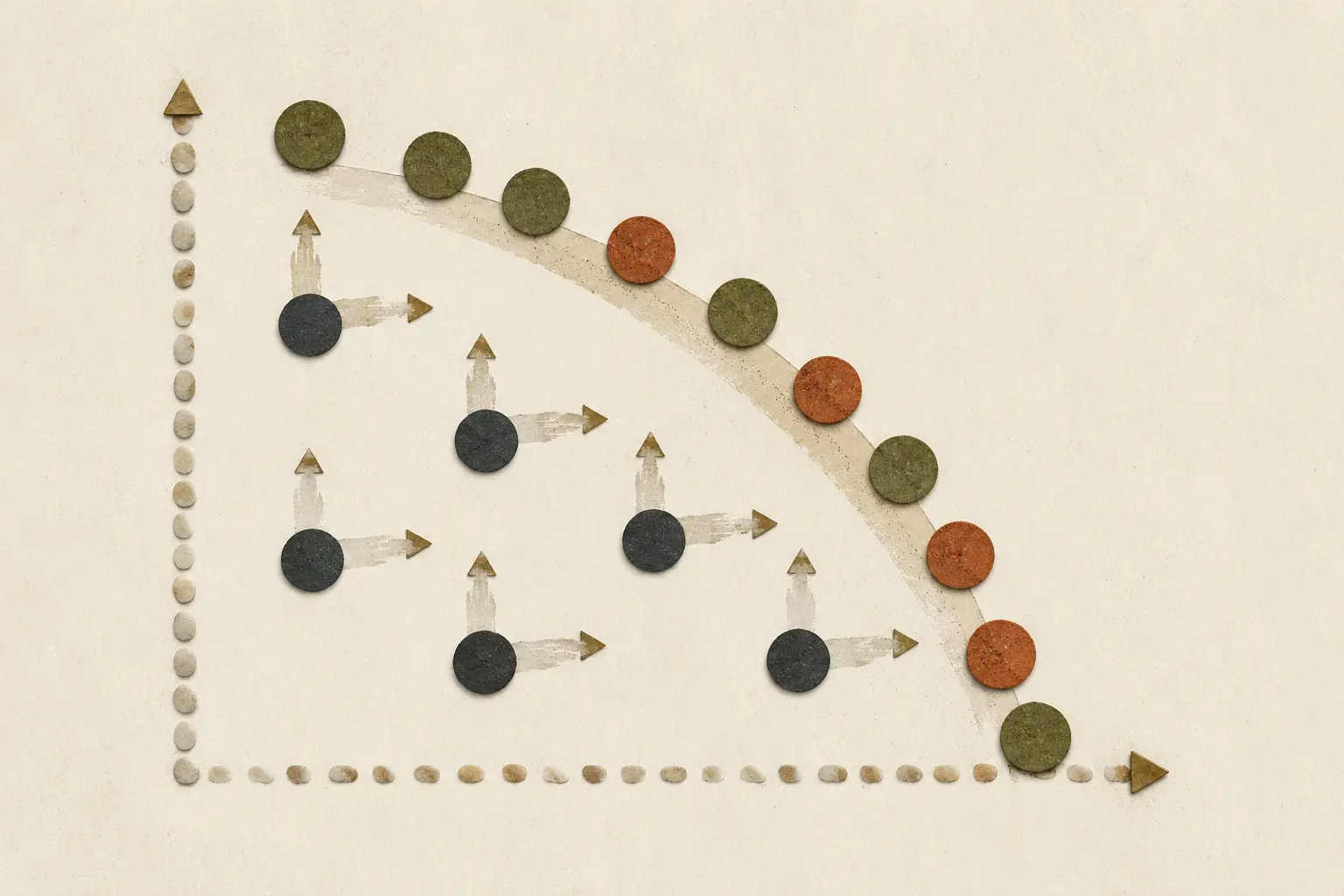
A plan can ask for more than people can actually deliver
A product team is asked to deliver ten significant features in six weeks with low operational risk.
The team sketches four plans:
- Plan A: six features in six weeks, with low risk.
- Plan B: ten features in ten weeks, with low risk.
- Plan C: ten features in six weeks, with high risk.
- Plan D: eight features in ten weeks, with high risk.
Plan D should disappear immediately. Plan B delivers more scope in the same time with lower risk. Plan C delivers more scope faster at the same high risk. Plan D has no meaningful advantage.
None of the remaining plans is best on scope, time and risk at once, so management has to say which outcome matters most.
Management may still ask for ten features, six weeks and low risk, even when the current team and system cannot produce that combination. The trade-off then appears as overtime, skipped testing or a narrower meaning of “done”, usually carried by the engineer expected to make the plan work.
Separate a better plan from a hard choice
The Pareto Frontier is the set of workable options where improving one thing means giving up something else.
An option is dominated when another available option is at least as good on everything that matters and better on one or more things. You can improve a dominated option without sacrificing anything.
Options on the frontier are non-dominated. Each asks for a real exchange between speed, cost, quality, scope, reliability or control.
This separates two conversations that teams often mix together:
- Improvement: Can we move from a worse option to one that is better across the board?
- Choice: Once the plainly worse options are gone, which trade-off fits our priorities?
Work out which trade-offs are actually there
For a real decision:
- Name the objectives. Include outcomes that matter even when they are hard to measure, such as reversibility, trust and human load.
- Map the options that can actually work. Use real constraints instead of wished-for combinations.
- Remove dominated options. If another option improves at least one objective without worsening any other, keep the better one.
- Inspect the frontier. These are the options where movement has an actual cost.
- Make the value choice openly. Say which objective matters more here and why.
- Ask what would move the frontier. New technology, fewer requirements, more time or a different system design may create combinations that are currently unavailable.
That last question matters because the frontier only describes what this team and system can do now. A redesign, more time or fewer requirements can change it.
How the frontier applies in optimisation, biology and product work
Mathematics and optimisation. When a problem has several goals, there may be no single best answer. The Pareto frontier keeps the options where improving one goal requires worsening at least one other. A weighted score can pick one, but the weights decide how much each goal counts. Looking at the frontier first makes that judgment visible.
Biology. An organism has limited energy for growth, reproduction, repair, speed and defence. If more defence has no cost, it can replace a worse trait combination. Near a biological limit, more armour may mean less speed or more energy. The shared idea is that a limited resource has to be divided. Evolution has no planner choosing a preferred answer, so the model only explains the trade-off among traits.
Product and organisational design. Roadmaps trade scope, time, reliability, cost and team load. Asking for the maximum of all five turns a real choice into hidden human work. Once the workable options are visible, leaders can choose a smaller release, a later date, more risk or an investment that creates better options. That makes overtime and skipped testing visible as costs of the plan instead of letting them hide the trade-off.
What the frontier can tell you
When comparing options, the frontier can reveal three very different conclusions:
- This option is dominated. Remove it because no value debate is needed.
- These options sit on the frontier. The disagreement is about priorities, not analysis alone.
- The desired option cannot be delivered within the current limits. Change one of those limits, add the missing skill, tool or capacity, or accept that the current team and system cannot deliver that combination.
Use this model for architecture choices, vendor selection, hiring plans, product scope, portfolio design, public policy and any decision where people keep asking for more of several competing outcomes.
It's especially useful when a meeting circles around “the best option” without agreeing on what best means.
What the frontier leaves out
A Pareto-efficient outcome can still be unfair, harmful or undesirable. One person can hold nearly everything and the result can still be Pareto efficient if helping anybody else requires taking something from that person.
The model depends completely on the goals and people you include. A cheap, fast plan can look better till customer trust, environmental harm or engineer exhaustion enters the comparison. Leaving a consequence out of the model does not make it disappear.
This is where Boundary Critique constrains the Pareto Frontier. Boundary Critique asks who and what the analysis includes, who it excludes and whose definition of improvement counts. If trust, environmental harm or team load is excluded, the frontier can't compare plans on those outcomes.
Theory of Constraints asks which limiting condition currently holds a system back. The Pareto Frontier asks which combinations of several goals are non-dominated. Removing a constraint can create better options, but it may still not produce one option that gives you everything.
Use the current frontier to choose among today's feasible plans, then decide whether more time, fewer requirements or a redesign could create better options.