Stigmergy
Can someone see what's been done and pick up the next task without having to ask?
People can work together with less chasing when what one person does helps the next person see what needs doing.
Imagine payments start failing on a busy afternoon.
One engineer is checking whether a company that processes the payments has a problem, while another is looking for a different way to send them. Someone needs to check whether that alternative is safe, and support needs an answer for customers whose payments are stuck.
The updates are scattered across private messages and group chats, so two engineers end up checking the same thing without knowing it. Someone suggests a fix, but nobody picks it up. A question gets answered in one chat while another team is still waiting for that answer. The person leading the response spends more and more time passing information between people.
Let the work show what needs doing next
Stigmergy describes how people or other living things can coordinate through changes they leave around them. One does something, and what changes helps the next one decide what to do.
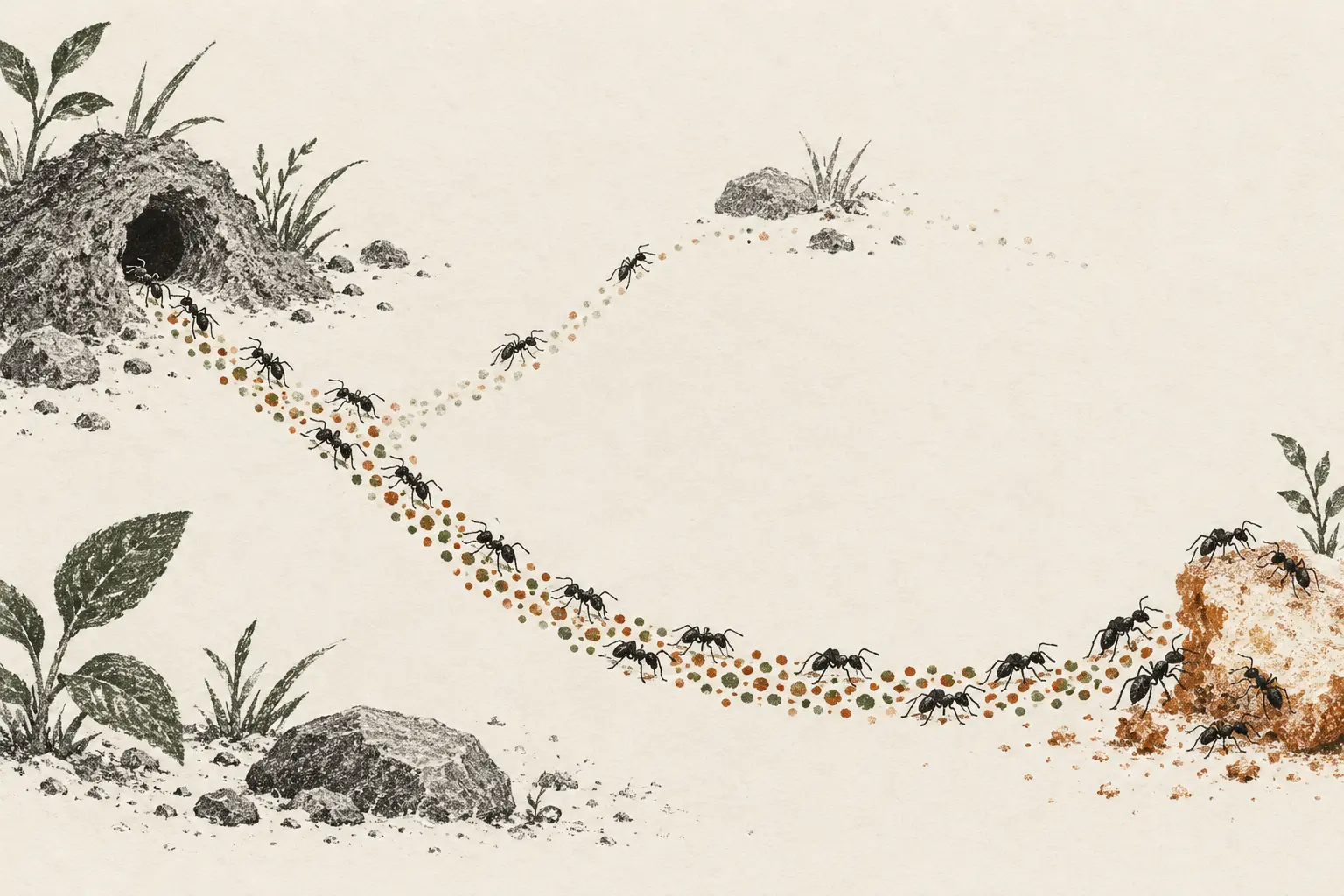
The term came from studying social insects. An ant leaves a chemical trail while travelling. Later ants follow it, and their own movement can make the trail stronger. No ant needs a full map or a meeting with the whole colony.
The ant example matters because the trail changes what the next ant does. Teams can use the same idea when one shared view shows who is doing what, what has already been tried and what remains open.
An empty shelf can tell a shop assistant to restock it without anyone asking. At work, moving a task into the review column on a shared board can tell a colleague it's ready for them. In both cases, doing the work leaves something behind that helps someone else act.
Give everyone somewhere to check
For the payment problem, the team could keep one shared page showing:
- What customers can't do at the moment
- The possible causes people are checking, and what evidence supports each one
- Work in progress, with one person responsible for each item
- Work that is finished, and what happened when it was tried
- Decisions already made that affect what people can safely do next
- The time each item was last confirmed
- When an update is old enough that someone needs to check it again
- When a temporary fix should be stopped or removed
Someone might start checking the database and mark that they're looking into it. The next engineer can see that and investigate something else. When they find something, they leave it where everyone can see it, including support, who can use it to update customers without chasing someone for an answer.
The person leading the response still needs to decide what to do next. But they spend less time asking who's doing what and passing updates between people, which gives them more room to work out what's happening and what needs attention.
A document written afterwards helps people understand what happened. During the problem, the page needs to help them decide what to do next, so keeping it useful matters more than writing a complete account.
Where else this happens
Biology
Ant colonies use nearby clues to decide which paths deserve attention. A route to food gets more traffic, which strengthens its chemical trail. The trail fades when it gets old, so an abandoned path stops attracting ants. The colony can coordinate without any ant understanding the whole pattern.
People are more complicated. They read the same update differently, have competing interests and can sometimes make their work look better than it is. Teams still need clear rules for who can update the shared page and how somebody can challenge a false claim.
Software and open collaboration
Software teams keep records of reported problems, code changes and test results. Someone in another time zone can see that a problem has been picked up, that a change needs review, or that a test failed. They can continue from there even after the person who did the earlier work has gone offline. Agents can use those records too, provided they check that the information is still accurate.
Shared work becomes dangerous when it says a task is complete while the system is still broken. Show when the update was made, who made it and what proves the task is done. Where two people might act on the same item, make the handoff clear and make repeated attempts safe.
Organisations, design and ordinary life
Cards on a task board show what people are working on and how much they already have to do. A hospital board shows which patient needs attention and what's already been done. An empty supplies bin left in an agreed place can tell someone to refill it. In each case, doing the work changes something the next person can see.
People still need to agree on what these signals mean. An empty bin in the wrong place might look discarded rather than ready for a refill, and an unusual situation may still need someone to make a decision.
Make the information easy to trust
Stigmergy helps when work is spread across people, happens at different times, repeats often or changes too quickly for one coordinator to repeat every update.
I'd ask six questions about how the team shares updates:
- Where do people look? If they must check several boards, they still have to piece together what's happening.
- What updates it? Where possible, doing the work should leave the update, rather than depend on somebody remembering to write it afterwards.
- What can the next person tell from it? Can they see who owns the work, what evidence exists and what they can do next?
- When is the update too old to trust? Show when it was last checked and when somebody should check it again.
- Who can correct it? People need a way to flag a task marked complete when it isn't, or an update that gives the wrong impression.
- When do people need to speak directly? Hard-to-reverse decisions, conflicts and unfamiliar emergencies may need a conversation or a clear command.
If people have to remember to update a board after doing the work, the board will drift. Where possible, let the work leave the update as part of the action itself.
What happens when the update is wrong?
This kind of system can also make mistakes spread. Early activity can make one path look correct, pull more people towards it and hide better alternatives. An old incident update can send several people after a problem that no longer exists. People can also game visible activity when the reward is looking busy rather than improving the outcome.
Too many boards, chats and dashboards recreate the original problem because people still have to search through them to find out what's happening.
Mark old updates clearly, show who changed them, and let people correct mistakes. When getting something wrong would have serious consequences, people still need to look at the evidence and discuss the decision themselves.
Nearby models
Common Knowledge is a public fact that everyone knows and knows that everyone else knows. It helps a group make a shared commitment, such as pausing a launch across the company. Stigmergy helps with ongoing work as each update guides the next person. People do not need to receive one announcement together.
Transaction Costs names the time spent finding people, translating context, agreeing, checking and enforcing an exchange. A shared page can reduce that time because ownership and evidence are easier to find. Transaction Costs explains why coordination takes effort. Stigmergy is one way to stop people repeatedly asking for the same update.
Use direct conversation for judgment, conflict and new situations. Keep ownership, evidence and results in one shared place so the team does not have to ask for the same update again and again.