Fitness Landscape
Making the current system better can make the move to a better design harder to justify.
A fitness landscape shows possible designs by how well they perform, including good local answers, better distant ones and the costly transition between them.
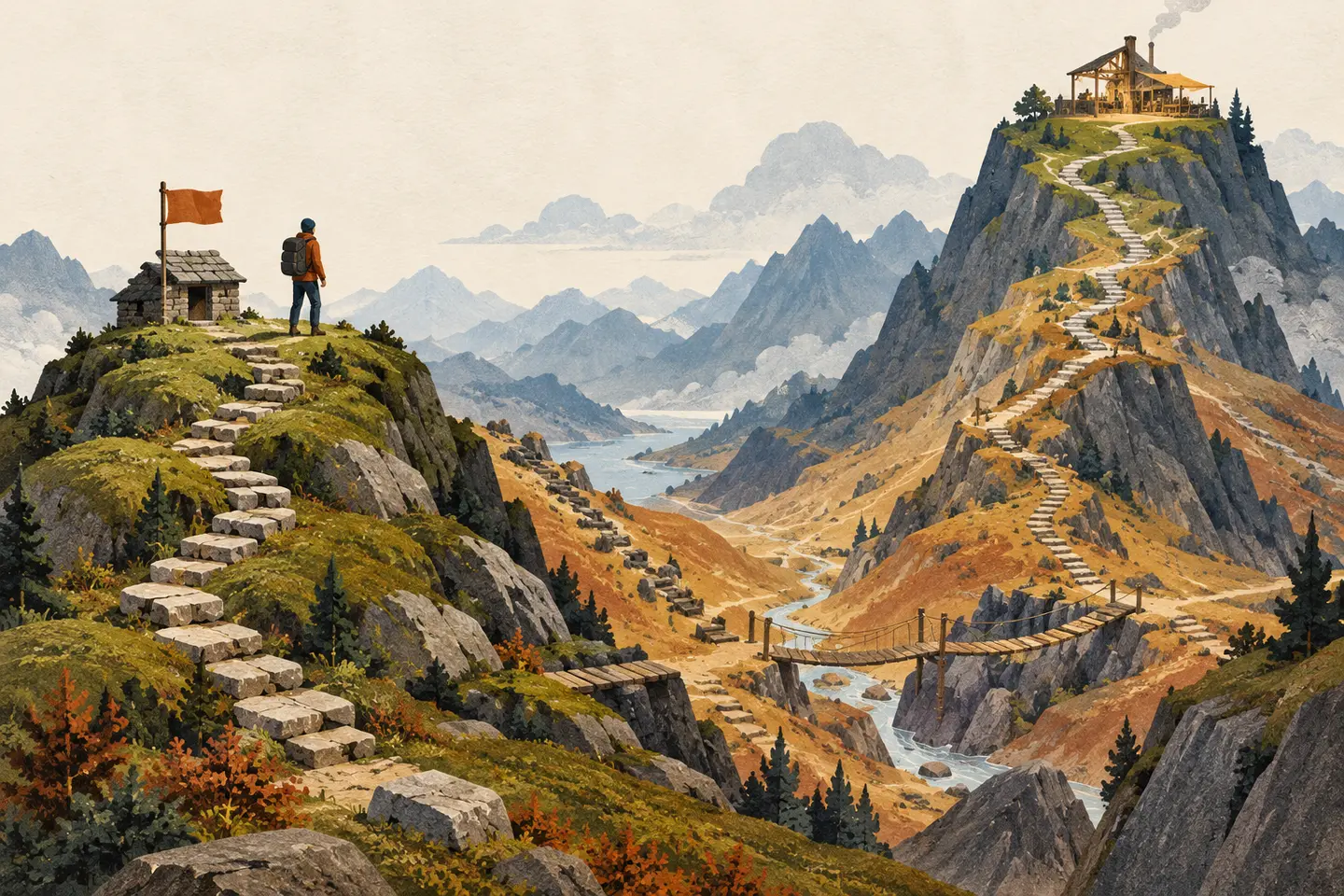
The team improved the review queue without reducing unnecessary reviews
A payment operations team manually reviews transactions that trigger a broad risk rule.
Over eighteen months, the team makes sensible improvements. It separates work into queues, creates reusable decision templates, sets approval thresholds, plans staffing and cleans up the dashboard. Reviews get faster, fewer cases are lost and each quarterly project leaves the process measurably better than before.
The process still sends too many ordinary customers into review.
One analyst resolves most of the cases that don't fit the templates. Another spends evenings reconciling decisions across systems. Customers with legitimate transfers keep waiting because the organisation has become excellent at moving cases through the existing queue rather than asking which cases should enter it.
A Fitness Landscape uses terrain to show possible designs:
- Each location is one possible design, strategy, organism or system.
- Nearby locations are designs you can reach through the changes currently available.
- Height shows how well each design performs under the conditions you chose.
- Peaks are designs that perform well.
- Valleys are the worse intermediate states you may have to cross.
When the current design has reached its limit
The review process has reached a local peak when none of the small changes it can make improves things much further. Another template, reviewer or approval rule gives less and less back.
A different design may sit on a higher peak:
- Low-risk transactions clear automatically within explicit limits.
- Ambiguous cases enter a bounded human queue.
- High-risk cases receive richer evidence and specialist review.
- Customers can see the state of a delayed transfer and appeal a mistake.
- Decisions update the model that selects future cases.
Getting there does not look like progress at first. During the move, the team has to run both systems, check decisions, train operators and fix gaps in the data. Throughput may fall before it rises. A quarterly scorecard can mistake that temporary dip for proof that the new design is worse.
Better macros and dashboards help, while also building skills, metrics and dependencies around the manual queue. That makes a temporary transition look worse beside a mature system.
What defines the landscape
The landscape metaphor, introduced in evolutionary biology by Sewall Wright in 1932, gives us three useful design questions.
Decide what performance means
In biology it concerns reproductive success in an environment. In an organisation it may combine customer outcomes, risk, cost, speed and operator load. If the chosen score ignores appeals or hidden work, the landscape rewards a system that transfers harm out of view.
Check which changes are actually reachable
Two designs are “nearby” when the system can move between them easily. A modular architecture makes swapping one provider a short move. A shared database, coupled release process or rigid approval chain may make the same change distant.
Recheck the options when the environment changes
A regulatory change, new competitor, larger scale or different user population can flatten yesterday's peak. Reaching a high point isn't the same as reaching a permanent answer.
Sometimes every small change keeps the system inside the same design. It may need a new way to represent the work, an interface or a decision right before a distant option becomes possible.
How this works in other fields
Evolutionary biology. Organisms with similar genes sit near one another on the landscape, and reproductive success determines height. Natural selection can move a population towards a nearby peak by preserving changes that help survival or reproduction. Mixing genes, random change, movement between populations or a changed environment can reveal routes that small improvements alone would not find. Unlike a team, evolution cannot picture a better design and fund the move in advance.
Mathematics, optimisation and software. Some search methods improve a solution one nearby step at a time. They work well when each step points towards the best answer, but can stop at a smaller peak when the terrain is uneven. Starting from a different place, making occasional larger moves or running several experiments can reveal another route. Software teams can also change which moves are possible: separating a system into replaceable parts can turn one dangerous rewrite into several smaller replacements.
Strategy and organisational design. Teams are usually rewarded for improving the system already running. A team proposing a temporary slowdown while it tests a better design can look weaker than one promising another small gain, because the cost is immediate and the benefit uncertain. Give the test its own small team, temporary capacity and a clear budget, and run it beside the existing process so today's service keeps working. Without that protection, the people doing the hidden work can carry the transition cost forever.
In each case, the next move has to be affordable enough to survive. A better design can still be unreachable through small improvements alone.
How to review the landscape
Use this model when:
- Several competent improvements have produced diminishing returns.
- A better design appears to require temporary regression.
- Teams dismiss alternatives because they don't beat the mature system immediately.
- Existing skills, metrics or architecture make only one family of changes easy.
- A decision process keeps selecting variations of the same answer.
- Environmental change may have moved the peak.
Work through seven questions:
- What is fitness? Name the outcome and guardrails, including hidden operating cost.
- Where are we? Describe the current configuration without confusing it with the goal.
- What counts as nearby? List the changes the system can make without losing viability.
- Are we on a local peak? Which permitted improvements are now producing little gain?
- What higher configuration can we describe? State its mechanism, not merely its aspiration.
- What valley separates us? Identify the temporary cost, uncertainty and people who would carry it.
- How can we test the transition with a pilot, parallel path, reversible migration or reserved capacity?
Pre-commit to how long the experiment is allowed to look worse and what evidence would justify continuing, expanding or stopping it. Otherwise the mature system will win every comparison simply because it has already paid its learning costs.
Where the metaphor can mislead
Real systems do not come with a visible, stable map of every possible design.
You may not know whether a higher peak exists. The objectives may conflict rather than collapse into one height. Other participants adapt while you move. A valley-crossing story can also become a grand excuse for an expensive rewrite that has no evidence behind it.
Do not treat every short-term decline as proof of a better future. Ask how the new design should produce the result, find relevant examples, limit the first exposure and decide what evidence would mean continue or stop.
The metaphor can also understate irreversibility. A biological population may disappear in a deep valley; a business can run out of cash, lose trust or harm customers during a migration. Preserve the current system's essential service while testing a new route.
The landscape is a way to think through the options. The real options and how they perform are usually uncertain, and they can change while you move.
Related models
The Explore–Exploit Trade-off asks how much capacity to allocate between known rewards and learning about alternatives. Fitness Landscape explains why search has structure: nearby exploration may keep finding the same local peak, while reaching another region requires a different move set or a temporary decline.
A Pareto Frontier keeps several competing objectives visible and shows solutions where one objective can't improve without worsening another. A fitness landscape often compresses those objectives into one height. If that compression hides customer harm, risk or operator exhaustion, the apparent highest peak may not be desirable at all.
Before improving faster, check which outcome your available moves can actually reach.