Ergodicity
A bet can have a positive average return and still leave you unable to keep taking it.
A positive average can still ruin one repeated path when each result changes what is left for the next round.
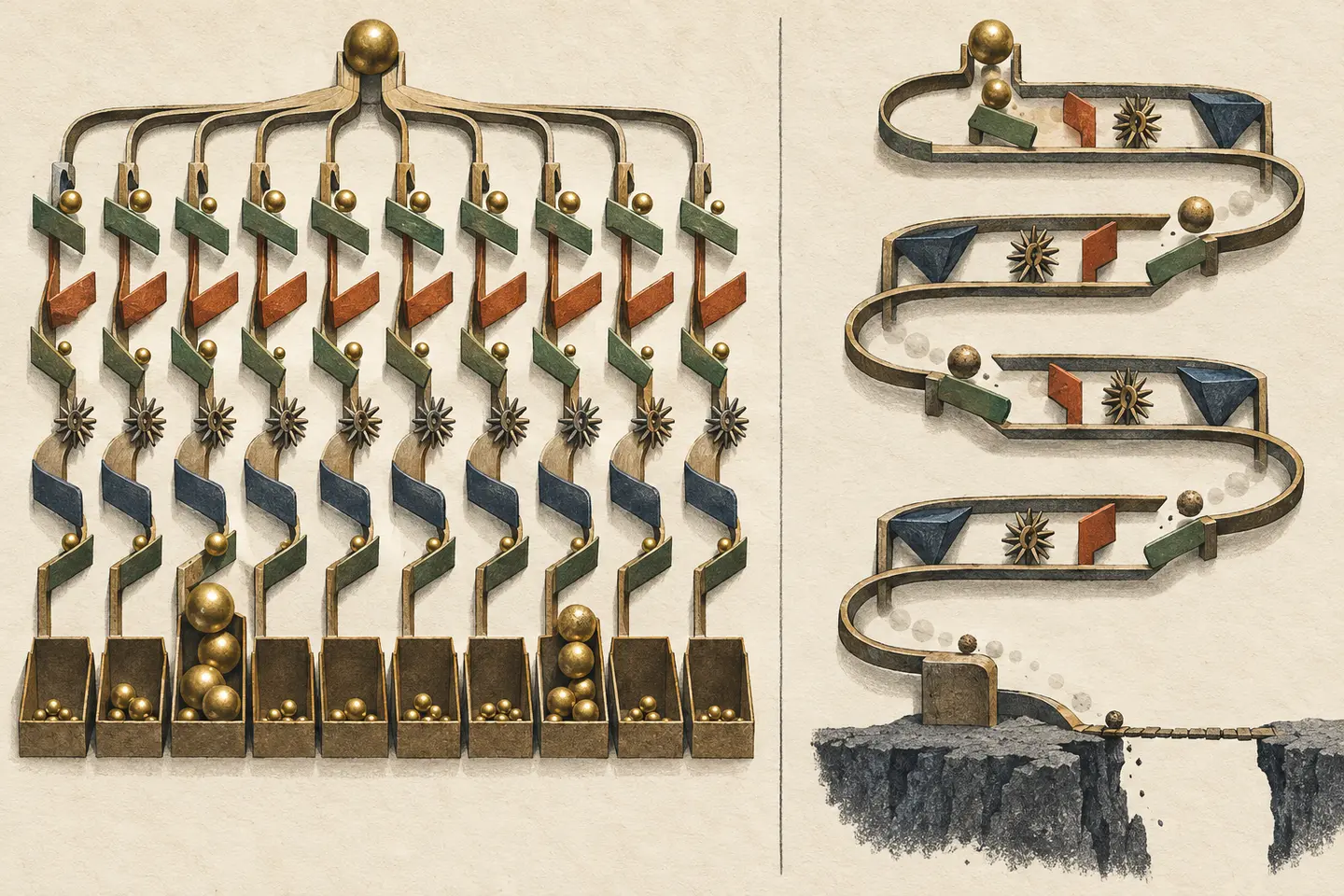
A positive expected return can still reduce the budget over repeated rounds
A small hardware studio has 100 units of prototype budget.
It finds a repeatable experiment with two equally likely outcomes:
- Success increases the available budget by 50 per cent.
- Failure reduces the available budget by 40 per cent.
The expected multiplier for one round is:
0.5 × 1.5 + 0.5 × 0.6 = 1.05
That looks like a five per cent expected gain, so the team keeps exposing the entire remaining budget.
The expected-value calculation is correct, but it leaves out what happens to one studio as each result changes the budget for the next round.
If many independent studios each run the experiment once, their average budget tends towards 105. That is an ensemble average: the average across many separate studios, each taking one turn.
One studio repeating the experiment experiences a different process. Every round starts with whatever survived the last one. With roughly ten successes and ten failures over twenty rounds, its budget becomes:
100 × 1.5¹⁰ × 0.6¹⁰ = 100 × 0.9¹⁰ ≈ 34.9
The expected budget across every possible twenty-round history is about 265.3. A small number of unusually successful histories pull that average upwards. A path with ten successes and ten failures ends at about 34.9, far below the 265.3 expected average.
The studio can't send copies of itself down every branch and collect the average later. It has one budget, and each result changes how much remains for the next round. When the budget becomes too small for the next prototype, the team cancels the supplier order, leaves a collaborator with an unfinished component and never reaches the later rounds where the upside was expected.
The spreadsheet averages every possible path. The team gets one path and needs enough budget left to take the next step.
Why the average isn't enough
Ergodicity describes whether the long-run average on one path matches the average across many independent copies at one moment.
When those averages differ, the process is non-ergodic for the quantity being measured. The order of outcomes, what remains after each one and whether the process can continue all matter.
The hardware gamble is multiplicative:
- A gain applies to the current budget.
- A loss also applies to the current budget.
- Later opportunities depend on the budget left by earlier outcomes.
Its typical long-run result is the geometric mean, which captures repeated percentage changes:
√(1.5 × 0.6) ≈ 0.949
That's a typical loss of about 5.1 per cent per round, even though the expected budget rises by five per cent per round.
The average can rise even when a typical repeated path loses money because every loss reduces the amount available for the next gain.
Questions to ask before trusting the average
When a decision will be repeated, inspect the process before trusting expected value.
What do you have left after each round?
The next round starts with whatever money, runway, trust, health, attention or system capacity survived the previous one. The outcomes may still be statistically independent, but their effect on the decision-maker compounds because each round starts with what the previous round left behind.
Is change additive or multiplicative?
Gaining or losing a fixed ten units is different from gaining or losing ten per cent of what remains. Multiplicative losses create asymmetry: a 50 per cent loss needs a 100 per cent gain to recover.
Is there a point you cannot come back from?
Bankruptcy, licence loss, permanent injury, corrupted data, and destroyed trust can end the process. An average that includes gains after you would have had to stop is not an outcome available to you.
Can exposure be shared across independent copies?
A diversified fund may hold many independent positions simultaneously and realise something closer to an ensemble average. One founder, one critical database or one reputation can't necessarily diversify itself in the same way.
The practical question becomes:
What will I still have available for the next attempt?
How the idea moves across fields
Physics and mathematics
In statistical mechanics, scientists compare what one system does over a long time with what many copies do at one moment. They can treat the two averages as the same only when the process is ergodic. If the system can get stuck in certain conditions, the order and the states it can still reach matter.
Ole Peters' 2019 Nature Physics paper brought this distinction into economic decision-making by examining cases where expected wealth and time-average wealth growth diverge. The narrower mathematical distinction is useful even if one doesn't accept every broader claim made under “ergodicity economics.”
Biology and evolution
A lineage lives through environmental conditions in sequence. A good year cannot compensate for an earlier extinction. Some organisms therefore spread risk across offspring, traits or generations, even when that reduces their best possible result. This is called bet hedging.
The connection is that an early failure can remove the chance to benefit from later good periods. A strategy with a lower average result in one period can be better over time if it keeps the lineage present for more periods.
Software, product and strategy
Suppose each software release that runs without a person supervising it has an independent one per cent chance of causing damage that cannot be undone. That sounds small. After one hundred releases, the probability of avoiding that event every time is approximately:
0.99¹⁰⁰ ≈ 36.6 per cent
Repeated exposure changes how the team should release software. Start with a small group, keep a way to undo the change, test away from the live system and protect enough time and money to recover, so one failure does not remove the ability to try again.
The same applies to organisations. Several projects may look independent while all rely on the same runway, reputation or review team.
Across these examples, later opportunities matter only when the current decision leaves enough money, health or system capacity to reach them.
Work through the actual path
Reach for Ergodicity when:
- A bet will be repeated.
- Gains and losses compound.
- One severe loss can end participation.
- Several projects share the same finite reserve.
- Expected value is driven by a small number of extreme outcomes.
- A proposal assumes later gains can repair an earlier irreversible loss.
- The choice affects the ability to make future choices.
Write down:
- State: What resource remains after each round?
- Dynamics: How does each outcome change that resource?
- Boundary: Which state ends or permanently weakens the process?
- Sequence: How many times will exposure recur?
- Dependence: Which supposedly separate bets depend on the same resource?
- Typical path: What does a typical path look like using the geometric mean or median?
- Exposure rule: What fraction can be risked while preserving the next attempt?
- Replenishment: How can that resource recover, and how long does recovery take?
Often the answer is to risk less on each attempt: run smaller experiments, protect a reserve, avoid borrowing so much that one loss ends the process and increase the bet only when enough remains for another attempt.
Where this model stops helping
Not every process is non-ergodic, and not every difference between an average and an individual outcome is an ergodicity problem.
Some risks can genuinely be pooled across many independent participants. Additive processes may make expected value a good guide. A person may rationally accept a temporary decline because income, insurance or another reserve restores the relevant state.
The model can also be used to justify excessive caution. Avoiding every volatile path also gives up meaningful upside. The model doesn't say “never risk ruin” without context, because some goals require accepting a real chance of failure and some institutions exist specifically to pool that risk.
The stronger claims of ergodicity economics, especially that time-average growth should replace expected-utility reasoning generally, remain disputed. A critique posted as an arXiv preprint argues that those claims go beyond what the mathematics establishes.
Use the model to reveal path dependence. The acceptable level of risk still depends on the goal and what must be protected.
Related models
Expected Value averages outcomes weighted by probability. That arithmetic mean is well defined whether or not one decision-maker can experience it. Before using it to choose a repeated action, ask whether losses change the ability to continue and whether the average is available through pooling or diversification.
Affordable Loss sizes an uncertain bet according to what can be lost while preserving the ability to act again. Ergodicity explains one reason that rule matters: in a sequential, multiplicative process, exposure changes the state from which every later opportunity must be reached.
Expected value describes the distribution of outcomes. Before using it for a repeated decision, check whether the likely sequence leaves you able to keep participating.